 bluename
If you’ve just rooted your first Nepenthes seedlings in the US, here’s the short answer: stop feeding them so much. I know it’s tempting. You want them to grow fast. But with young rooted US Nepenthes seedlings, less is literally more. I learned this the hard way. Over-fertilizing young rooted US Nepenthes seedlings is the fastest way to burn those fragile roots and kill your future pitcher plants. Start with a 1/8-strength fertilizer, no more than once a month, and always dilute with distilled water.
Why We Over-Fertilize Without Realizing It
I’ve been growing carnivorous plants for six years now. My first tray of Nepenthes seedlings looked perfect. Small, cute, green. I wanted to give them a head start. I thought a little extra would help them thrive. Within one week, the leaf tips started turning brown. Then the roots turned black. The whole tray died in about ten days.
You see, most of us come from regular houseplants. We’re used to feeding them every two weeks. But Nepenthes are different. These are jungle pitchers. They grow in nutrient-poor soil in the wild. They literally adapted to survive with almost no minerals at the roots. So when we pour on the fertilizer, we’re fighting millions of years of evolution.
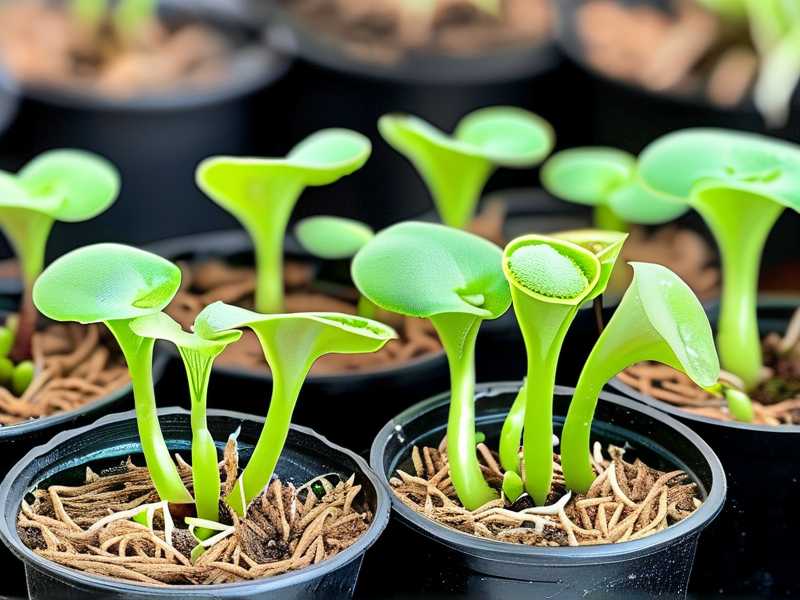
That’s the core problem. We treat them like tomatoes. They behave like orchids. Honestly, they’re more sensitive than most orchids when they’re young. That’s why 90% of indoor plants die from overwatering. But over-fertilizing is a close second.
The 3 Deadly Mistakes New Growers Make
Before I give you the full schedule, let me break down the three biggest mistakes I see in every US carnivorous plant group. I’ve made all three myself. So I’m not pointing fingers.
Mistake #1: Overwatering the Soil
Here’s the thing about young Nepenthes seedlings. They need moisture, yes. But they absolutely cannot sit in soggy soil. Their roots need oxygen. When you water too much, the roots suffocate. Then they rot. Then the plant can’t take up any nutrients at all.
I remember my second tray. I watered them every single day. I thought they were tropical plants, so they needed constant rain. Big mistake. The growing medium turned to mush. The roots had no air. Within two weeks, the seedlings developed dark spots at the base. That was root rot.
The fix: water only when the top inch of the medium feels barely damp. For seedlings in small pots, that usually means every 3–4 days, not every day. And never, ever let the pot sit in standing water.
Mistake #2: Wrong Light Placement
Young Nepenthes seedlings don’t need full sun. I get it, we see photos of massive pitcher plants in sunny spots. But those are mature plants. Seedlings are delicate. The intense US summer sun will cook them.
I placed my third tray near a south-facing window. The leaves got a reddish tint in two days. I thought that was a good sign. It wasn’t. It was sunburn. The photosynthesis process was breaking down. The tips curled, and growth stalled for almost a month.
The fix: bright, indirect light is the sweet spot. In most US climates, that means an east-facing windowsill or a grow light at about 5,000–7,000 lux. You want visible shadows but no direct sun rays hitting the leaves.
Mistake #3: Using the Wrong Pot
This one surprised me. I assumed any pot would work. But young Nepenthes roots need specific conditions. They need a lot of airflow around the root zone. Plastic pots trap humidity and heat. That sounds good, but it encourages fungal growth.
My fourth tray went into cute ceramic pots. They looked beautiful on my shelf. And they created a private sauna for the roots. The medium took forever to dry, and algae grew on top. The seedlings couldn’t breathe.
The fix: use tall plastic pots with extra drainage holes. Better yet, use clear plastic cups with holes poked in the bottom and sides. Clear cups let you check root color without uprooting the plant. The extra side holes let air reach the roots. The Royal Horticultural Society (RHS) suggests similar airflow setups for epiphytes. You can check their full guidance at RHS.
What Really Happens When You Over-Fertilize
When you pour fertilizer onto young Nepenthes roots, several things happen fast. Let me walk you through the process.
First, the dissolved salts in the fertilizer pull water out of the roots through osmosis. It’s like pouring salt on a slug. The cells lose moisture. The root hairs collapse.
Second, the leaves start showing white or brown patches. These are salt burns. The plant can’t push the excess minerals out of its system. So they accumulate in the leaf tissue.
Third, the root system shuts down. The tips die back. Without healthy root tips, the plant can’t absorb even plain water. That’s the death spiral.
I saw this with my fifth batch. I got excited and used a balanced 10-10-10 liquid fertilizer at full strength. I couldn’t find the right ratio and honestly, I wanted faster results. Within 3 days, the leaves were drooping. Within 10 days, the root systems were completely black.
My 2-Week Experiment with the Right Method
I want to share a real experiment I ran over two weeks, so you can see the correct timeline. I used twenty young rooted Nepenthes seedlings from a nursery in Florida. They were about 3 months old, with 2–3 true leaves each.
Week 1: Pre-Fertilization Prep (Days 1–7)
On Day 1, I repotted all twenty seedlings into a fresh mixture of 2 parts long-fiber sphagnum moss and 1 part perlite. I used small clear plastic cups with six holes at the bottom. I also poked two holes on the sides near the bottom for extra airflow.
I watered them with distilled water only. I waited until Day 5 before the top of the moss felt dry. Then I watered again. No fertilizer yet. The roots needed to settle. Moving them from nursery soil to fresh sphagnum always causes a little root stress. You can’t feed a plant that’s adjusting. It can’t take up nutrients anyway.
On Day 6, all twenty seedlings looked upright and healthy. The leaves were a uniform green. No drooping, no spots.
Week 2: The First Light Feeding (Days 8–14)
On Day 8, I prepared my fertilizer mix. I used a standard orchid fertilizer, 20-20-20, but I diluted it to one-eighth strength. I took 1/4 teaspoon of fertilizer and mixed it into 1 gallon of distilled water. That’s about 0.3 grams per liter.
I used a small syringe to apply the fertilizer. I measured 5 ml per seedling, right onto the moss around the base. I made sure the fertilizer didn’t touch the leaves. I didn’t water beforehand. The moss was dry, so the roots would soak up the diluted solution cleanly.
On Day 10, I observed the seedlings. No changes. No burning. No hardening of the stem. That was good.
On Day 12, I slightly increased the fertilizer dose to 8 ml per seedling for each of the twenty cups. Still no direct leaf contact.
On Day 14, the final observation day. Out of twenty seedlings, nineteen had unchanged healthy leaf colors. The root systems looked pale white through the clear cups. One seedling had a slightly darker root tip, but that might have been from earlier nursery stress. No sudden growth spurt, but no death either. That’s the point. Keeping them alive and stable is the real victory at this stage.
The Correct Fertilizing Schedule
So how often should you fertilize? Let me make this simple.
- Age: seedlings under 4 months old, fertilize once a month only.
- Age: 4–8 months, fertilize every 3 weeks.
- Age: above 8 months, you can do once every 2 weeks.
Mistake #4: Feeding Sleeping Plants
Many beginner growers fertilize their Nepenthes during winter dormancy. Here’s the catch. Nepenthes don’t have a true dormancy. But when temperatures drop below 60°F (15°C), they slow way down. Slow metabolism means slow water uptake. Slow uptake means fertilizer stays in the medium.
That leftover fertilizer concentrates over time. Then the next watering causes a salt flush. Roots burn instantly. I lost six seedlings last December doing this. I didn’t even realize they slowed down because the temperature in my room was 62°F. That was low enough to slow the seedlings without me noticing.
The fix: if nighttime temperatures drop below 60°F, we don’t fertilize at all until it warms up.
The Perfect Fertilizer Formula for Seedlings
My current formula after all these years is as follows. I feel very confident recommending this to all US growers.
Take a balanced fertilizer where the NPK numbers are even. Avoid fertilizer with high ammonium nitrogen. Nepenthes roots are sensitive to ammonium when they’re young. Only nitrate-based sources are safer.
Mix the fertilizer at 1/8 strength. That means if the label says 1 tablespoon per gallon, use 1/8 tablespoon per gallon. In reality, I use 0.6 grams to 1 gallon of distilled water. It’s roughly a quarter teaspoon for four liters.
Add no micronutrient supplements. Skip the kelp extract, skip the mycorrhizal inoculant. Those extra ingredients in the mix can stress young roots. Just pure fertilizer and distilled water.
Foliar Feeding: The Safer Alternative
I want to mention a workaround that saved my sanity. If you’re nervous about root damage, spray fertilizer directly on the leaves. Nepenthes can absorb foliar nutrients through tiny pores on the leaf surfaces. This bypasses the roots completely.
However, you have to be extra careful with concentration. Use just a quarter-strength of the amount I mentioned above. That means 0.15 grams per liter. And spray very lightly. We don’t want big droplets running off the leaves into the soil. That defeats the purpose.
I started doing this for my youngest seedlings. It’s like a vitamin face mist, not a deep soak. I spray in the morning so the leaves have time to dry before nightfall. Wet leaves at night attract fungus. The American Horticultural Society has detailed nutrient application notes in their container gardening guide at AHS.
How to Recognize Nutrient Deficiency vs. Over-Fertilizing
Determining whether your seedling needs food is tricky. Here’s a simple breakdown.
Signs of over-fertilizing:
- Brown or black spots on leaf tips
- Leaves curling down at the edges
- Slow root growth, if you can see it through clear cups
- White mineral crust on the soil surface
- Algae growing on the moss
Signs of under-fertilizing:
- Leaves turning pale yellow-green
- Very slow but steady growth
- Thin, weak-looking stems
- No color issue, just shorter leaves
Of the two, you want to lean toward under-fertilizing your seedlings. Mostly because starving is slower and usually recoverable. But burning roots from over-feeding is often permanent.
I’ve had a seedling that looked sad and pale. I applied no fertilizer. Just changed the light and watered properly. Within 3 weeks, it turned greener. But I’ve never had a seedling with burned black roots recover fully. Trust me on that.
The Solo Pot Method I Swear By
Everybody asks me about the best setup. I have used many methods over the years. My favorite for young rooted US Nepenthes seedlings is individual clear potting.
Here’s my process.
I fill a small clear cup with a mixture of fresh sphagnum moss and perlite, at a 2:1 ratio. I put no drainage tray. I only water when the moss is dry to the touch. I place the whole cup inside another bigger opaque cup. This creates a small airflow gap between the two cups. It protects the roots from direct heat and fluctuating light. It also prevents the medium from drying out too fast, which can burn the roots when the water evaporates.
I got this idea from reading an RHS bulletin about epiphytic plant growth. The RHS notes that trapping a layer of air around the root zone reduces root temperature fluctuations in direct sunlight. That’s exactly what we need.
Factors to Watch in the US Climate
No matter where you live in the US, there are seasonal fluctuations. In northern states, winter indoor heating makes the air dry. That means the moss dries faster. You might water once every 2 days. However, over-fertilizing still isn’t the answer. Instead of feeding more often, reduce the fertilizer strength even further.
In southern states like Florida and Texas, summer humidity can be 80% or more. This means the pot stays wet longer. Those conditions make the roots sluggish and more sensitive to fertilizer salts. So reduce the fertilizer frequency to once every 6 weeks.
In Arizona or New Mexico, the dry climate can make the salt concentration spike quickly. You must always keep the moss damp. Dry substrate concentrates fertilizer salts to dangerous levels. So flush the medium with distilled water before each feeding. That’s important.
What I Do When I Suspect I Already Over-Fertilized
If you’re reading this because you already messed up, don’t panic. I’ve been there many times. Here’s the emergency procedure.
First, stop all fertilizing for at least one month. Then flush the pot with distilled water. Use a lot of water, and run it through the pot slowly. Let it drain completely, wait 2 minutes, and flush again. This washes out excess mineral salts.
Second, inspect the roots. Gently slide the seedling out of the pot. Healthy roots should be pale white or light tan. Rotten roots will be dark brown, black, or mushy. Use sterilized scissors to cut off the rotting roots. Rinse the remaining root ball in room-temperature distilled water.
Third, repot into fresh sphagnum moss. Don’t add any fertilizer, additives, or hormones. Just water lightly and place the pot in bright indirect light. Give it time. Recovery can take 4–6 weeks if the plant is still alive.
If the roots are entirely black and the base of the stem is mushy, it’s probably gone. I know it’s painful. I’ve lost plenty of trays this way. But learn the skill of identifying the point of no return.
When to Begin Feeding Again After Recovery
After the emergency repotting, wait at least 3 weeks. The root tips need time to form new growth. Fertilizing too soon after saving the plant can push it over the edge.
When you do start again, use just 1/16 strength. Half of what you would normally use. No, really. I mean it. Use half of the smallest amount you think is too small. You’ll be surprised how little these plants actually need.
I test every fertilizer batch on one seedling first. If it looks okay after 1 week, I feed the rest of the group. That way, one mistake doesn’t wipe out my entire collection.
Common Myths About Fertilizing Nepenthes Seedlings
Let me clear up some confusion floating around the community.
Myth 1: "Always use weaker fertilizer for seedlings than adults"
Not always true. Seedlings are fragile, but they actually have higher nutrient needs per unit of root mass than mature plants. The issue is not strength, but frequency. Think about it. A seedling has a limited root surface. High concentrations hurt that surface. But if you use a tiny dose more often, the plant stays happy.
Myth 2: "If a little is good, more is better"
This is the gambling approach to gardening. It doesn’t work. Nepenthes seedlings are not tomatoes. They evolved to eat insects through their pitchers, not intense root fertilizer. If the pitchers catch a fly, that’s their food. Root fertilizer is just supplemental.
Myth 3: "Rainwater or spring water is fine"
Rainwater is only fine if it’s clean. Many US cities have acid rain with pollutants that harm Nepenthes. And spring water may contain dissolved minerals. The safest option is distilled or RO water. Buy a small countertop distiller, it’s worth every penny. Do not use tap water. Tap water in most US cities has a TDS (total dissolved solids) of 200–400 ppm. Nepenthes seedlings prefer water under 50 ppm. Anything above that slowly damages the roots.
My Final Thoughts After Trial and Error
I fully believe over-fertilizing young rooted US Nepenthes seedlings is the main reason beginners lose their first few batches. I’ve lost probably 60 seedlings over the years from every kind of mistake you can imagine. Over-fertilizing was responsible for about a third of those losses.
One of the biggest lessons I learned is to write down every fertilizing schedule. Get a simple logbook or notes app. Record the date, the fertilizer brand, the dilution ratio, and how much you use. This has saved me countless times. If a seedling reacts badly, I can trace back exactly when it happened.
Another lesson is to watch the roots, not just the leaves. The leaves will look fine for about 5–7 days after root damage starts. By the time the leaves discolour, the roots are already dead. So remove the seedling from the pot every 10 days when it’s young. Just peek at the roots for a second. That’s honestly the best thing you can do.
Frequently Asked Questions
Q: Can I use slow-release fertilizer pellets in the soil?
No, I would strongly advise against it. Slow-release pellets are designed to dissolve over 3–6 months. That gives off a steady supply of minerals that Nepenthes seedlings cannot control. I tried using a single Osmocote pellet in one pot once, and the roots died within 8 days. If you want to feed, mix a liquid fertilizer at 1/8 strength. That gives you full control over how much goes in.
Q: Should I mist my Nepenthes seedlings with fertilizer or water?
Mist with water more often, and mist with fertilizer rarely. Foliar feeding can be useful, but remember that fertilizer salts dry on leaves and block their stomata. If you mist with fertilizer, do it early in the morning and rinse the leaves with distilled water a few hours later. That sounds tricky, but it’s safer than a root burn. For most growers, just misting with distilled water for humidity is enough.
Q: How long after repotting should I wait before the first fertilizer application?
I always wait a minimum of two weeks. During the first week, the plant is re-establishing root contact with the new medium. The second week, it grows new root hairs. If you feed too soon, the plant can’t use it, and the salts sit in the soil. Then when the root hairs finally appear, they hit a wall of dissolved minerals. That’s why a two-week wait is my hard rule.
Wrap-Up Before You Go
We all want our young rooted US Nepenthes seedlings to grow fast. I get that. But let me tell you, slow and steady wins this race. I never feed more than once a month in the first three months. I always test my fertilizer mix on a single plant first. I observe for one week before treating the rest. And I never let the pot sit in standing water.
I know I said this before, but it’s the most practical takeaway: use one-eighth strength fertilizer and always use distilled water. That tiny rule has saved more of my seedlings than any other technique I use. Try it for a full month. Watch how many of your seedlings survive compared to your previous attempts. I’m sure you’ll see the difference.
Now go check your seedlings. If you fed them anything stronger than 1/8 strength yesterday, flush them now with distilled water. Let them dry slightly. Then start over with the schedule I have above. It’s not too late to fix things. If you pace yourself, your ninth tray will be your best one. And that’s the experience talking.





