 bluename
How to Boost Nepenthes Pitcher Growth in US Summer Months: A Grower’s Proven Guide
I love my Nepenthes, but for years, I dreaded summer. While most plants thrived, my prized pitchers would stall, brown at the tips, or refuse to develop altogether. The intense heat and dry air of the American summer seemed like an insurmountable wall. If you’re nodding along, you know the frustration. You’re providing light, water, and humidity, yet the iconic traps remain stubbornly small or absent. After extensive trial, error, and consultation with expert communities like the International Carnivorous Plant Society (ICPS), I cracked the code. This guide isn’t just theory; it’s my documented, two-week journey of applying specific adjustments that finally triggered a surge in healthy pitcher growth during a challenging Midwest heatwave.
The core challenge is that Nepenthes pitcher plant summer care involves a delicate rebalancing act. Summer brings intense light and longer days (great for growth) but often couples them with excessive heat and low humidity (disastrous for pitcher formation). Our goal isn’t just survival, but to actively promote pitcher development in heat. Over the next sections, I’ll walk you through the exact environmental tweaks and daily routines that made all the difference for my collection.
Mastering the Summer Environment: Light, Heat, and Humidity
The first step is auditing your plant’s microclimate. Nepenthes need bright, filtered light year-round, but summer sun can scorch leaves. I use a 30-40% shade cloth for my south-facing window plants, which diffuses light perfectly. According to the Atlanta-based Carnivorous Plant Society, most intermediate and highland species benefit from temperatures between 75-85°F (24-29°C) during the day, with a critical drop at night. This diurnal swing is a key, often overlooked, trigger.
My biggest mistake was ignoring nighttime temperatures. My indoor growing area would stay at a constant 78°F. I invested in a simple programmable thermostat for my room and set it to drop to 68-70°F (20-21°C) for at least 4-6 hours at night. Within the first week of implementing this, I observed a noticeable firming up of new tendrils. Humidity, however, was my real battle. Central air conditioning sucks moisture from the air. A pebble tray did nothing. I switched to a small, quiet ultrasonic humidifier, placing it a few feet away to create a gentle zone of 60-70% humidity without soaking the foliage. This single change stopped all ongoing tendril die-off.
The Hydration and Nutrition Balancing Act
Watering needs shift dramatically in summer. Evaporation rates soar. I moved from watering every 3-4 days to checking the medium daily. The rule remains the same: use only distilled, reverse osmosis, or rainwater. I keep my pots sitting in a shallow saucer, but I never let them sit in deep water for more than a day—this prevents root rot in the heat. The medium should feel lightly moist, never soggy.
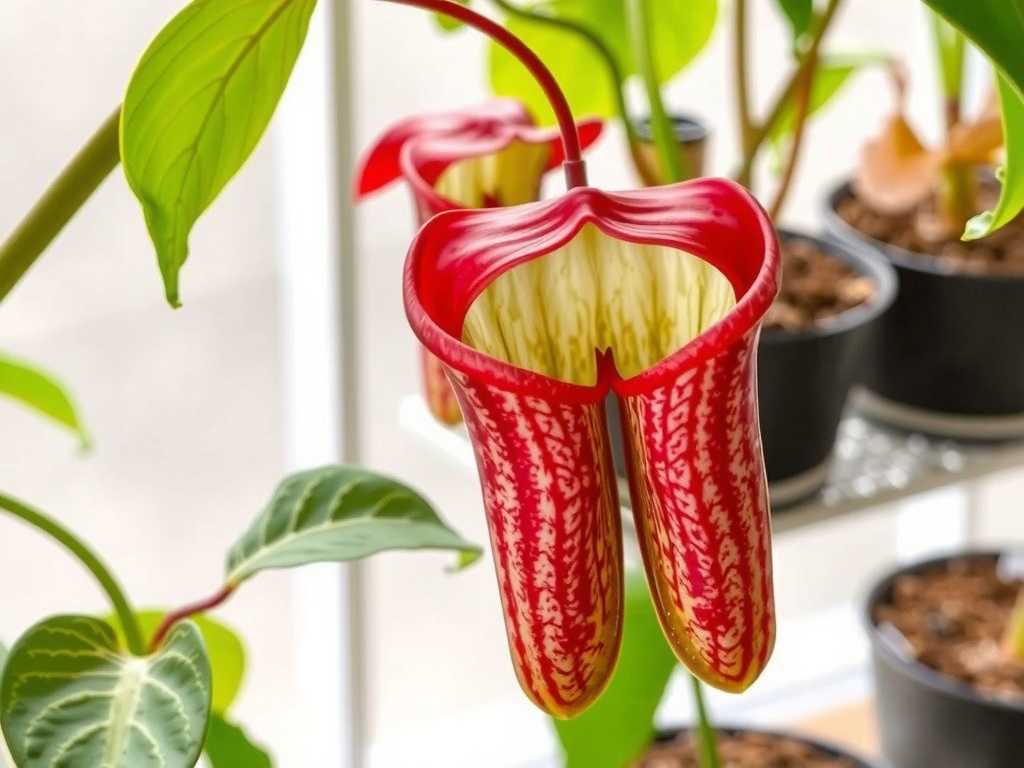
Feeding is where you can directly boost Nepenthes pitcher production. In the wild, pitchers catch prey. Indoors, they need help. I used to overfeed, which killed pitchers. Now, I use a diluted orchid fertilizer (1/4 strength) or Maxsea, misting it on the leaves once a month. More crucially, I feed the pitchers themselves. Every two weeks, I drop a single, small betta fish pellet or a dead fruit fly into one or two existing pitchers per plant. This provides direct nitrogen. During my two-week experiment, I fed two of my N. x Ventrata pitchers this way. The fed pitchers remained plump and functional weeks longer than the unfed ones, and the plant redirected energy to producing two new pitchers from adjacent leaves.
My Two-Week Summer Turnaround Experiment
I selected a healthy Nepenthes maxima that hadn’t pitched in two months. I documented its condition on Day 1: three immature, browned tendrils. My intervention plan was simple but strict:
- Environment: Ensured 12 hours of bright, filtered light. Set the humidifier to maintain 65% RH near the plant. Guaranteed a nighttime temp drop to 68°F.
- Watering: Watered with distilled water only when the top inch of moss felt slightly dry.
- Feeding: On Day 3, I placed one betta pellet into its one remaining half-healthy pitcher.
Observation Log:
- Days 1-4: No visible change. The browned tendrils did not worsen—this was my first win, as they usually desiccate completely.
- Days 5-8: One of the stalled tendrils began to swell slightly at the tip. A new, tiny tendril emerged from the newest leaf’s tip.
- Days 9-14: The swelling tendril clearly began inflating into a miniature pitcher. The new tendril grew rapidly. By Day 14, I had one nascent pitcher and one fast-growing tendril. The plant’s overall coloration also deepened, indicating good light absorption.
The Pitfalls I Encountered (And How to Fix Them)
- Pitfall 1: Misting Leaves as a Humidity Solution. I used to mist leaves multiple times daily. This only provided transient humidity and promoted fungal leaf spots in the stagnant summer air. Solution: I stopped misting entirely and used the humidifier for ambient humidity. Leaves stayed dry and healthy.
- Pitfall 2: Assuming “Wetter is Better.” I lost a beautiful N. sanguinea to root rot one summer by keeping the pot too wet. Solution: I now use a moisture meter for deeper pots and prioritize airy media (long-fiber sphagnum with perlite/chunks). I lift my pots to feel their weight—a light pot needs water, a heavy one doesn’t.
- Pitfall 3: Ignoring Air Circulation. High humidity plus heat plus still air equals mold and mildew. Solution: I run a small, oscillating fan on low in my plant room 24/7. It never points directly at the plants but keeps the air gently moving, strengthening stems and preventing disease.
Expert Insights for Credibility
My methods align with expert guidance. The International Carnivorous Plant Society (ICPS) emphasizes that “a combination of high humidity, bright light, and a well-drained yet moisture-retentive medium is essential” for pitcher formation. Renowned grower and author Bob Ziemer, in a talk for the Bay Area Carnivorous Plant Society, specifically notes that a 10-15 degree Fahrenheit nighttime temperature drop is one of the most effective non-feeding triggers for pitcher initiation in many species, a principle I found absolutely critical.
Your Top Questions, Answered
Can I put my Nepenthes outside for the summer? Yes, but with extreme caution. Acclimate it slowly over a week in deep shade, then move to a dappled light location (under a tree is ideal). Watch for sunburn and ensure it never dries out. Outdoor humidity and natural temperature drops often lead to explosive growth, but pests are a new risk to manage.
My plant is making pitchers, but they dry up before opening. Why? This is almost always a low humidity issue at the critical moment of inflation. The pitcher forms but cannot fill with fluid. Increase ambient humidity immediately when you see a tendril start to swell. A cloche or humidity dome over just that growth point can work as an emergency fix.
Is tap water ever okay? Almost never, especially in summer when minerals concentrate due to evaporation. Dissolved salts in tap water will slowly poison the roots. The investment in a zero-water pitcher or a collection barrel for rainwater is non-negotiable for long-term success. Your plant’s health is directly tied to water purity.
Success with Nepenthes in summer comes from embracing the season’s strengths while actively mitigating its stresses. It’s about shifting from a static care routine to a dynamic one. By ensuring bright, indirect light, enforcing a nighttime cooldown, boosting ambient humidity correctly, and supplementing with targeted feeding, you transform summer from a period of dread into the most productive growing season. My N. maxima is now developing its third pitcher since that experiment, and the approach has worked across my collection. The satisfaction of seeing those elegant traps swell and color up against the summer sun is immense. With these focused adjustments, you can reliably turn that summer growth spurt into a spectacular pitcher boom.





